
The Galápagos Islands
“Tourists don’t know where they’ve been, travelers don’t know where they’re going.”
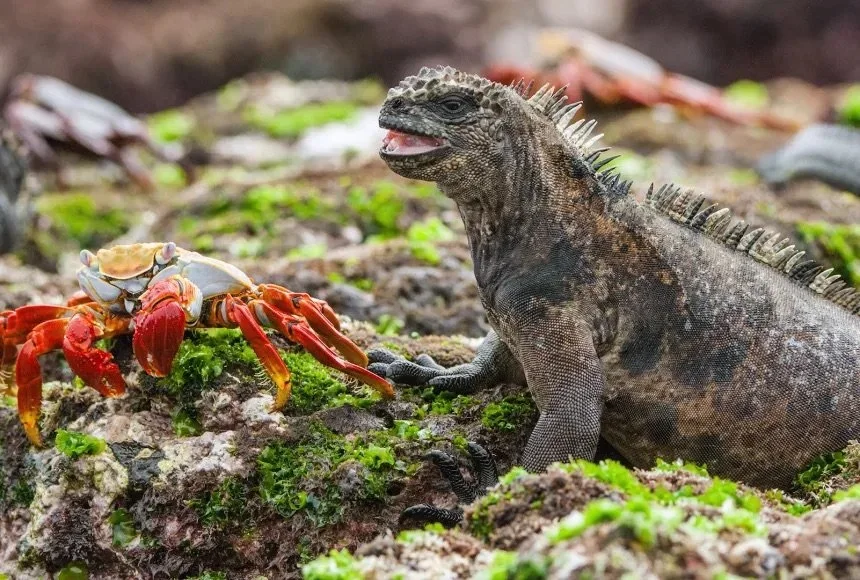
A marine iguana and a brilliantly colored Sally Lightfoot crab sharing the rocky shoreline.
Our Family Adventure: Ecuador, the Galápagos & Guadeloupe
Our family journey took us to some of the most remarkable landscapes in the Americas—from the mountains and rich cultural traditions of Ecuador, to the extraordinary wildlife of the Galápagos Islands, and finally to the tropical beauty and French-Caribbean character of Guadeloupe.
Ecuador, a small country straddling the equator, contains an astonishing variety of landscapes and ecosystems. Within a relatively short distance, the scenery changes from sunny Pacific beaches to the cool grasslands and volcanic peaks of the Andes and the lush tropical rain forests of the Amazon basin. Colonial towns and mountainside villages add another dimension, with colorful markets, traditional foods, local crafts, and a fascinating mixture of cultures.
About 600 miles off Ecuador’s Pacific coast lie the Galápagos Islands, an isolated volcanic archipelago unlike anywhere else on Earth. Thirteen major islands and numerous smaller islands and islets make up the chain, with Isabela—the largest—stretching roughly 80 miles from end to end. Millions of years of volcanic activity created a dramatic landscape of mountains, lava fields, rugged shorelines, and volcanic formations.
The Galápagos sit near the equator, yet cool ocean currents flowing through the region create an unusual mixture of tropical and temperate conditions. Combined with the islands’ extreme isolation, these conditions allowed plants and animals to evolve in remarkable ways. The result is a living laboratory of evolution, filled with distinctive species and ecosystems found nowhere else on Earth. Experiencing these landscapes and encountering the islands’ wildlife up close made the Galápagos an unforgettable part of our family adventure.
Our travels also took us across the Caribbean to the Guadeloupe Islands, an overseas region of France. This archipelago encompasses five principal island groups, each with its own personality. The two largest and most populated islands, Grande-Terre and Basse-Terre, are connected by bridges, while Marie-Galante, Les Saintes, and La Désirade are reached by ferry.
With the Caribbean Sea to the west and the Atlantic Ocean to the east, Guadeloupe offered another spectacular island environment—multicolored beaches, dense tropical forests, waterfalls, rugged cliffs, and coral reefs. Grande-Terre serves as the main gateway and tourism center, while mountainous Basse-Terre is home to Guadeloupe National Park and the active La Grande Soufrière volcano. Les Saintes offered yet another contrast, blending French culture and sophistication with the relaxed rhythms and natural beauty of the Caribbean.
From Ecuador’s Andean landscapes to the volcanic shores and remarkable wildlife of the Galápagos, and from Guadeloupe’s rain forests and waterfalls to its Caribbean beaches, our family trip brought together an extraordinary range of landscapes, cultures, and experiences. Although each destination was completely different, they shared a common theme: dramatic environments shaped by volcanoes, oceans, isolation, and time. Together, they made for a family adventure filled with discovery and some truly unforgettable places.